

Advanced Certification in Deep Learning – IISc Bangalore
The PG Level Advanced Certification Course in Deep Learning is offered by the Center of Continuing Education at IISc in collaboration with TalentSprint. This 10-month weekend program enables both aspiring and practicing AI/ML professionals to build expertise in Deep Learning. The program covers essential theoretical foundations and practical applications through a unique 5-step learning process including live interactive sessions, capstone projects, mentorship, case studies, and campus visits. Students gain hands-on experience in applying deep learning techniques to real-world scenarios while building a compelling portfolio. The program focuses on optimizing machine learning algorithms for hardware and edge computing systems, covering areas like speech, text, image, and video processing.
₹ 3,72,000
Overview
The IISc Deep Learning program offers comprehensive training in advanced AI techniques, combining theoretical foundations with practical applications through expert faculty guidance and hands-on projects.
Why Technology & Analytics?
This program stands out for its unique blend of academic excellence from IISc faculty, industry-relevant curriculum, and practical experience through real-world projects and mentorship.
What does this course have to offer?
Key Highlights
Live interactive sessions by leading faculty
Two-day campus visit to IISc Bangalore
Mentorship from researchers and practitioners
Industry-relevant capstone projects
Comprehensive curriculum covering all aspects of deep learning
Who is this programme for?
Working professionals with coding experience
Aspiring AI/ML professionals
Data scientists and analysts
Software engineers
Research professionals
Minimum Eligibility
Graduate in any discipline from recognized university with minimum "satisfactory" or Grade C equivalent
One year work experience required after degree completion
Not sure whether you qualify for this programme?
Admission Overview
The admission process involves submitting an application, document verification, and selection based on educational background and work experience. The academic structure includes weekend classes, practical sessions, and campus visits.
Here's a Glimpse of Your Degree
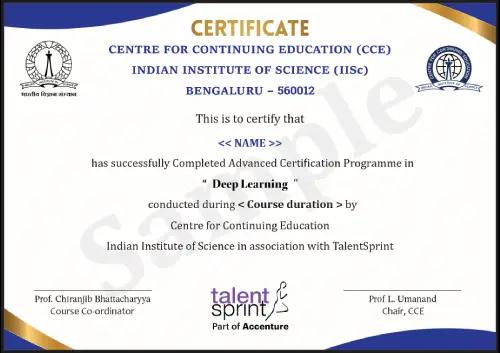
*Disclaimer: The image is for illustrative purposes only and may be subject to change at the discretion of Management.
Selection process
How to apply?
Curriculum
The curriculum covers mathematical foundations, machine learning basics, deep learning architectures, NLP, speech processing, computer vision, reinforcement learning, and edge computing applications.
There are 10 semesters in this course
The program delivers comprehensive coverage of deep learning fundamentals and applications through nine core modules plus capstone projects. Students learn theoretical foundations and practical implementations across various domains including computer vision, NLP, speech processing, and edge computing. The curriculum emphasizes hands-on experience through projects and case studies.
Module 1: Mathematical Preliminaries and Data Visualization|Weeks|10||Covers the core mathematical foundations for machine learning, including linear algebra, probability and statistics, numerical optimization, and techniques for visualizing data.|Linear Algebra, Probability and Statistics, Numerical Optimization for ML, Data Visualization
2 Weeks to complete
Module 2: Introduction to Machine learning|Weeks|2||Introduces the foundational paradigms of machine learning, covering both supervised and unsupervised learning approaches.|Supervised Learning, Unsupervised Learning
2 Weeks to complete
Module 3: Deep Learning Architectures|Weeks|5||Explores core deep learning architectures and training techniques, from logistic regression through CNNs, RNNs, and LSTMs, along with backpropagation and regularization methods like dropout and batch normalization.|Logistic regression, Neural Networks - CNN, RNN, LSTM, Backpropagation, Deep networks, Regularization, Dropout, Batch Normalization
5 Weeks to complete
Module 4: Deep Learning for Natural Language Processing|Weeks|5||Covers deep learning techniques for NLP, from distributed word representations and language modeling through GRUs, LSTMs, attention, GPT and BERT variants, to recurrent architectures for translation, classification, and text generation.|Introduction, Distributed word representations, Language Modeling, Convolutional neural networks for Text, GRUs, LSTMs for Language Modeling, Attention and Applications, GPT, BERTs and Variants, Recurrent Neural Networks (Unidirectional and Bidirectional), Machine Translation, POS, Sentence Classification, Text Generation
5 Weeks to complete
Module 5: Deep Learning for Speech and Audio Processing|Weeks|4||Covers deep learning approaches to audio and speech, including audio representations, speech recognition, end-to-end deep networks, and detection models.|Audio representations for deep learning, Speech Recognition, End-to-end deep networks, Detection Models
5 Weeks to complete
Module 6: Deep Learning for Computer Vision|Weeks|5||Covers popular CNN architectures, transfer learning and autoencoders, object detection and image segmentation, and RNN/LSTM approaches for image captioning and video.|Popular CNN architectures, Transfer learning, autoencoders, Object detection, image segmentation, RNN and LSTM for image captioning/video
3 Weeks to complete
Module 7: Deep Reinforcement Learning|Weeks|3||Introduces sequential decision making under uncertainty and covers implementing reinforcement learning algorithms with deep neural networks, including value functions for finite and infinite problems.|Introduction to sequential decision making under uncertainty, Implementing RL algorithms with deep neural networks., Value functions, Finite and infinite Problems
4 Weeks to complete
Module 8: Deep Learning for IoT/Edge Devices|Weeks|4||Covers ML hardware options for IoT and edge devices, energy efficiency and optimization techniques, and building ML models tailored for edge deployment.|Overview of various ML hardware for IoT/Edge devices, Energy Efficiency, IoT/Edge Devices Optimization techniques, ML Model for Edge Devices
5 Weeks to complete
Module 9: Representation Learning|Weeks|5||Explores deep generative models and semi- and self-supervised learning techniques for learning useful data representations.|Deep Generative Models I, Deep Generative Models II, Semi and Self-supervised Learning I, Semi and Self-supervised Learning II
5 Weeks to complete
Capstone Projects||||Applies deep learning techniques to real-world, research-driven problems across speech, NLP, vision, IoT, and generative modeling domains, including healthcare diagnostics, legal prediction, recommender systems, and adversarial robustness.|COVID-19 detection using acoustic sounds, Use of NLP models for solving simple Math Word Problems, Study of Practical BERT models for Sequence Labeling, Prompt Learning for Vision Language Models, Training a speech recogniser using data from speech synthesis, Training a Voice conversion model, Reinforcement Learning based Task Offloading in Mobile Edge Computing, Anomaly Detection in Industrial IoT, Federated Multi-Armed Bandits based Recommender System, Interpretable GAN Controls, Crafting Adversarial Samples for Deep Models, Monocular Depth Estimation, Text only training for Image Captioning, Zero-shot segmentation using Stable Diffusion, Open set zero shot classification via stable diffusion, Knowledge distillation for Speech Recognition, Time series forecasting via LLMs, Lesion Boundary Segmentation, Neural Models for Legal Judgement Prediction, Optic-Disk-Cup Segmentation and Classification
Programme Length
This is a 10-month weekend program featuring live interactive sessions in a flexible format designed for working professionals. The program also includes a two-day campus visit for hands-on learning and networking opportunities.
Whom you will learn from?
Learn from top industry experts who bring real-world experience and deep knowledge to every lesson. The instructors are dedicated to help you achieve your goals with practical insights and hands-on guidance.





Tuition Fee
The program fee is ₹3,72,000. Application fee is ₹2,000.
Fee Structure
Payment options
Financing options
Need help understanding fees, EMI options, or scholarships?
Loading alumni...
About the University
Established in 1909 with active support from Jamsetji Tata, IISc is India's premier public research university located in Bengaluru, Karnataka. The institute has evolved into a leading institution for higher education and advanced research in science, engineering, design, and management. With over 40 departments and centers, IISc offers diverse programs spanning sciences, engineering, and technology, maintaining its position as a global leader in research and innovation

#211
QS world ranking
#251-300*
The world ranking
2
NIRF overall rank
Affiliation & Recognition


Affiliation & Recognition
Featured Faculties
These are the expert instructors who will be teaching you throughout the course. With a wealth of knowledge and real-world experience, they're here to guide, inspire, and support you every step of the way. Get to know the people who will help you reach your learning goals and make the most of your journey.

49
Students
1
Course
Career services
IISc provides comprehensive career support through its Office of Career and Counselling and Placement (OCCAP). The institution offers extensive placement assistance, including pre-placement talks, training sessions, and grooming activities. Students receive personalized career guidance, interview preparation, and access to industry connections. The placement cell works closely with over 3,500 corporate partners to ensure strong placement outcomes and career growth opportunities. The institute maintains impressive placement records across undergraduate, postgraduate, and doctoral programs, with particular emphasis on research and technology sectors
86LPA
highest package
28LPA
average package
100%
placement rate
Top Recruiters









₹ 3,72,000
Frequently asked Questions
Below are some of the most commonly asked questions about this course. We aim to provide clear and concise answers to help you better understand the course content, structure, and any other relevant information. If you have any additional questions or if your question is not listed here, please don't hesitate to reach out to our support team for further assistance.